May 14, 2026
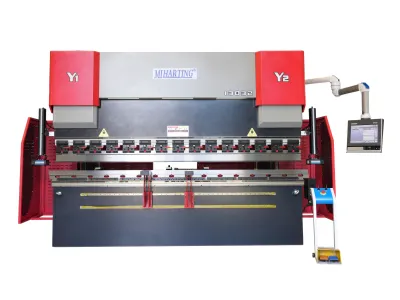
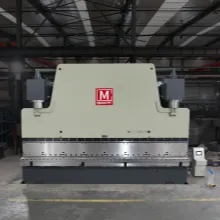
A torsion axis press brake (often called a torsion axis synchronous bending machine) is a type of hydraulic bending machine that uses a rigid torsion shaft to connect the left and right oil cylinders to achieve mechanical forced synchronization. It is characterized by a simple structure, high cost performance, and suitability for conventional precision sheet metal bending.
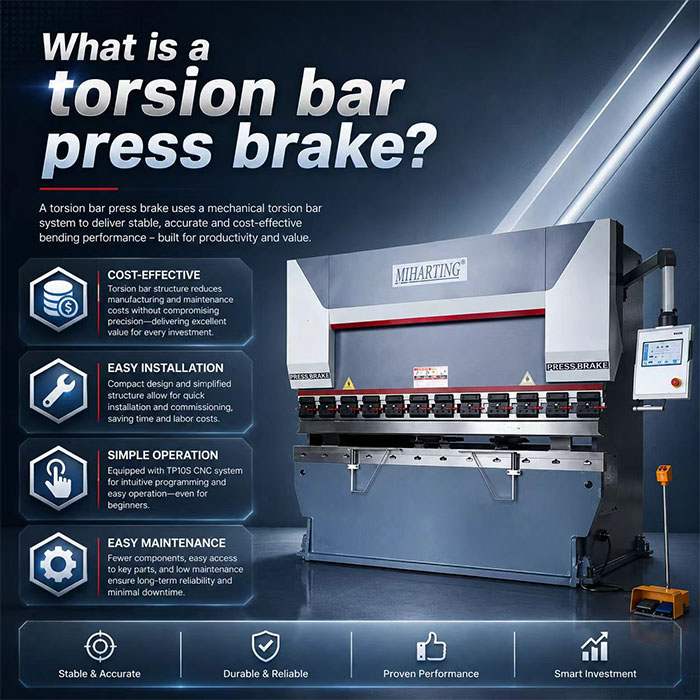
Synchronization Core (Torsion Axis): A alloy steel torsion shaft running through the machine body, with its two ends connected to the left and right cylinder swing rods. When the slider moves downward, the elastic torsion of the torsion shaft forces the two cylinders to synchronize, ensuring the slider is parallel and the bending angle is consistent.
Power: Motor + hydraulic system, driving the left and right oil cylinders to drive the slider up and down.
Control: Mostly open-loop CNC/digital display. Input the angle and size, and the system controls the stroke and back gauge; there is no real-time feedback from the linear scale, and the precision is guaranteed by mechanical rigidity.
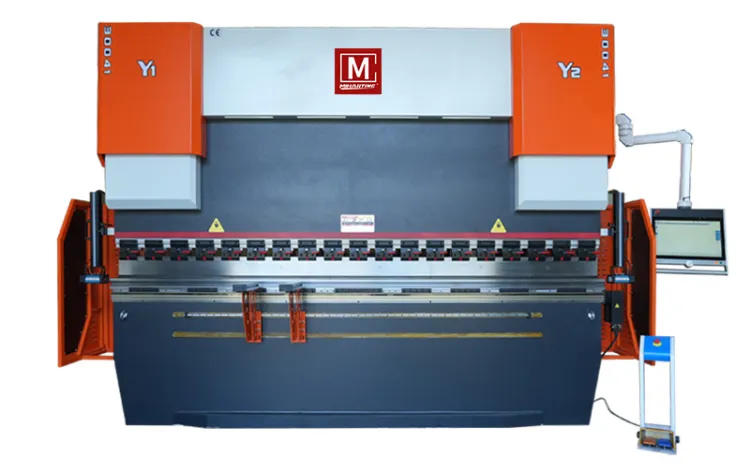
Typical Structure: Frame, slider, workbench, upper and lower molds, torsion axis synchronization mechanism, hydraulic station, CNC system, back gauge.
Low Price: About 60%–70% of the price of electro-hydraulic synchronous machines, suitable for small and medium-sized enterprises with limited budgets.
Stable and Durable: The mechanical synchronization structure is simple, with few failures and low maintenance costs.
Easy to Operate: The CNC system is easy to get started, suitable for batch conventional bending.
General Precision: Conventional precision is ±0.1~±0.2 mm, not suitable for high-precision products.
Weak Unbalanced Load Capacity: Long-term one-sided force is likely to cause torsion shaft deformation and reduced synchronization precision; try to bend in the center as much as possible.
No Real-Time Compensation: Open-loop control cannot dynamically correct errors like electro-hydraulic machines.
Comparison Item | NC Press Brake | CNC Press Brake |
|---|---|---|
Synchronization Method | Mechanical torsion axis forced synchronization | Electro-hydraulic servo + linear scale closed-loop control |
Precision | ±0.1~±0.2 mm | ±0.02~±0.05 mm |
Price | Low | High |
Application Scenarios | Shelves, cabinets, ordinary sheet metal | Automotive, aerospace, precision sheet metal |
Shelves, file cabinets, distribution boxes
Building metal components, door and window frames
Ordinary agricultural machinery, equipment casings
Tonnage and Table Length: Select according to the thickness and length of the sheet metal (e.g., 100T/3200 mm).
CNC System: Ordinary digital display (economical) or simple CNC (multi-step bending).
Mold Configuration: Standard upper and lower molds, with segmented molds added as needed.
Unbalanced Load Working Conditions: If one-sided bending is often required, it is recommended to pay extra for an electro-hydraulic synchronous model.

 English
  中文
中文