Dec 27, 2025

An ironworker machine delivers faster return on investment and lower operating costs for punching, shearing, and notching structural steel, while laser cutting machines excel in precision cutting of flat sheet metal and complex geometries. The right choice depends on material type, production volume, tolerance requirements, and total ownership cost—not on cutting technology alone.
For most structural steel and general fabrication workshops, an ironworker machine is significantly more cost-effective. Laser cutting machines involve higher capital investment, greater energy consumption, and more complex maintenance. Ironworkers provide multiple metalworking functions in one compact machine, reducing equipment count and floor space.
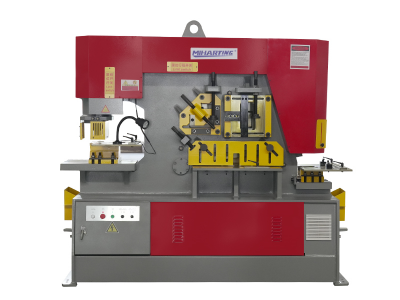
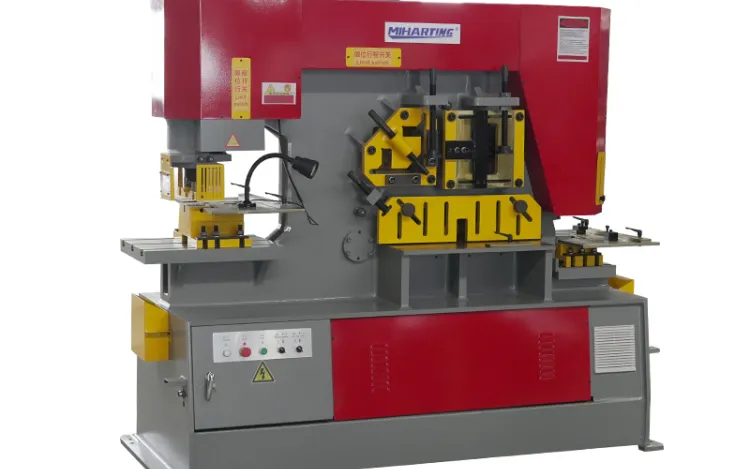
An ironworker machine combines punching, flat bar shearing, angle cutting, notching, and optional pipe or channel processing into a single hydraulic system. It is designed for high-force operations on thick materials commonly used in construction and structural fabrication.
Typical materials:
Angle steel
Flat bar
Channel and beam sections
Thick steel plates
Key advantage:
High-speed processing of structural profiles without complex programming.
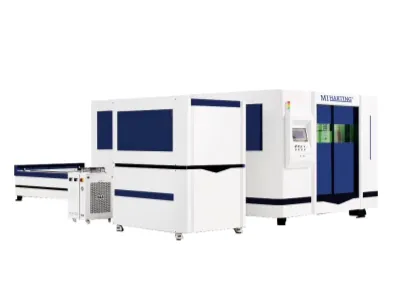
Laser cutting machines are optimized for high-precision cutting of sheet metal, especially thin to medium thickness materials.
Typical materials:
Carbon steel sheets
Stainless steel sheets
Aluminum sheets
Key advantage:
Excellent edge quality and intricate contour cutting with minimal secondary processing.
An ironworker machine typically requires a moderate upfront investment, making it accessible for small to medium-sized workshops.
Lower purchase price
Minimal installation requirements
No need for specialized foundations or cooling systems
Laser cutting machines involve:
High equipment cost
Advanced CNC control systems
Optical components and resonators
Additional costs for exhaust, cooling, and power infrastructure
The initial cost difference alone can be several times higher compared to an ironworker machine.
Ironworker machines generally consume less energy per operation, especially when processing thick materials. Hydraulic systems are efficient for punching and shearing tasks and do not require continuous high-power consumption.
Consume significant electrical power
Require assist gases (oxygen, nitrogen)
Need temperature-controlled environments for stability
Over time, these factors increase total operating expenses.
For repetitive operations such as punching holes, cutting angles, or shearing flat bars, an ironworker machine is often faster. There is minimal setup time, and operators can switch operations quickly.
Laser cutting machines require:
CAD file preparation
Program loading and nesting
Sheet positioning and alignment
Laser systems outperform ironworkers only when producing complex shapes in flat sheet metal.
Laser cutting machines provide superior dimensional accuracy and edge finish for detailed components. Ironworker machines focus on functional accuracy, suitable for structural and load-bearing applications where extreme precision is not critical.
In practical fabrication terms:
Ironworker accuracy meets construction and structural standards
Laser accuracy supports decorative, aerospace, and precision manufacturing
Ironworker machines occupy significantly less floor space and can replace multiple standalone machines. This improves workflow efficiency in compact workshops.
Laser cutting machines require:
Large machine footprint
Sheet loading and unloading areas
Material storage and handling systems
Ironworker machines have a simpler mechanical and hydraulic structure:
Fewer sensitive components
Lower risk of sudden system failure
Easier on-site servicing
Laser cutting machines involve:
Optical alignment
Resonator maintenance
Software and control system updates
Downtime costs are generally higher for laser systems.
You process structural steel daily
Your work includes punching, shearing, and notching
You need fast throughput with minimal setup
Cost control and ROI are top priorities
You produce complex sheet metal parts
Precision and edge quality are critical
You handle large volumes of flat sheet metal
You have the infrastructure and budget to support higher operating costs
In many professional fabrication shops, ironworker machines and laser cutting machines complement each other. Ironworkers handle heavy-duty structural tasks, while laser systems focus on precision cutting. This hybrid approach maximizes efficiency and broadens production capabilities without overloading a single machine type.
Selecting between an ironworker machine and a laser cutting machine should be driven by material type, production requirements, and long-term operating costs. Ironworkers continue to be one of the most efficient solutions for structural steel processing, while laser cutting remains unmatched for complex sheet metal work.
Understanding these differences ensures your investment supports both current production needs and future growth.
 English
  中文
中文