Nov 11, 2025
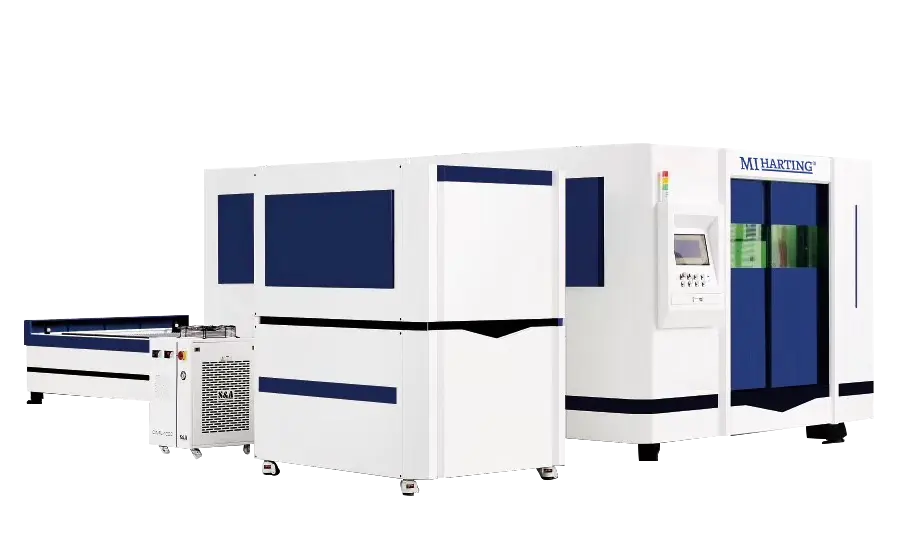
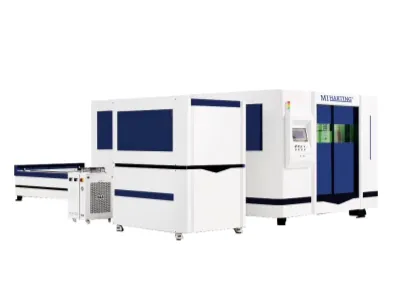
A CNC laser cutter is a thermal processing machine that does not require direct contact with the workpiece. It uses a laser head to focus a high-energy-density laser beam onto the material. When the powerful beam is concentrated on the metal, the thermal energy density increases dramatically, instantly melting and vaporizing the area exposed to the ultrafine focal spot.
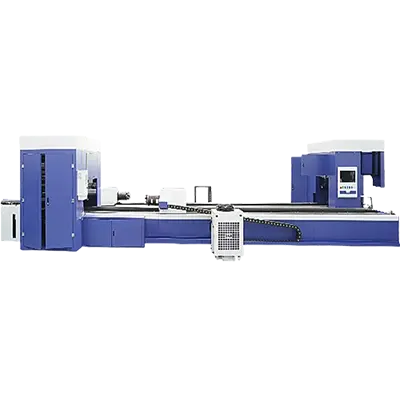
A CNC laser cutter consists of several key components: a laser emitter, cutting head, beam transmission unit, machine tool worktable, numerical control system, computer (hardware and software), cooling unit, shielding gas cylinder, dust extractor, and air dryer.
The CNC laser cutter operates by directing a focused, high-power-density laser beam across the surface of the workpiece. In a fraction of a second, the material is locally heated to thousands or even tens of thousands of degrees Celsius, causing it to melt, vaporize, combust, or ablate. Simultaneously, a high-speed gas stream coaxial with the laser beam blows away the molten material, thereby cutting through the workpiece. In some cases, the gas also reacts exothermically with the material, providing additional energy to aid the cutting process. The gas flow also cools the cutting surface, minimizes the heat-affected zone, and protects the focusing lens from contamination. Laser cutting is fundamentally a thermal cutting process.
Compared to other thermal cutting methods, laser cutting technology offers distinct advantages. The main characteristics can be summarized as follows:
High Cutting Quality
Due to the small laser spot, high energy density, and fast cutting speed, a CNC laser cutter can achieve excellent cutting quality. The cut is narrow, and the dimensional accuracy of cut parts can reach ±0.05 mm. The cut surface is smooth and clean, with a surface roughness typically between Ra 12.5 to 25 µm. In many cases, laser cutting can be the final processing step, with the cut seam requiring no further finishing before welding or assembly.
High Cutting Efficiency
Thanks to the laser's transmission properties, a CNC laser cutting machine often incorporates multiple CNC worktables, enabling full automation of the cutting process. By simply changing the control program, the device can cut parts of various shapes. It supports both two-dimensional and three-dimensional cutting operations.
Clean, Safe, and Non-Polluting
During operation, the cutting head does not contact the workpiece, eliminating tool wear. To process different part shapes, no tool changes are needed—only laser output parameters need to be adjusted. The CNC laser cutting device operates with low noise, minimal vibration, and zero pollution, significantly improving working conditions for operators.
Wide Range of Cuttable Materials
Compared to oxy-acetylene and plasma cutting, the laser cutting device can process a broader range of materials. These include metals, non-metals, metal-based and non-metal-based composites, leather, wood, and textiles. Different materials exhibit varied laser cutting adaptability due to differences in thermal properties and laser absorption rates.

 English
  中文
中文