May 28, 2026
Are you researching Hydraulic Press Brake Price? Discover the 5 critical factors—from DELEM CNC systems to frame processing—that determine the cost and quality of your machine.
Why do press brakes with an identical appearance on the market range in price from $20,000 to $200,000? Price is not merely a number; it is a reflection of the machine's precision, service life, and production efficiency.Accurately understanding the pricing of hydraulic press brakes is central to corporate budgeting and maximizing ROI. It exerts a significant influence on both initial capital investment and long-term production efficiency. Analyzing the factors that influence pricing can help you avoid the pitfalls of low-cost options and maximize the value of your company's assets.
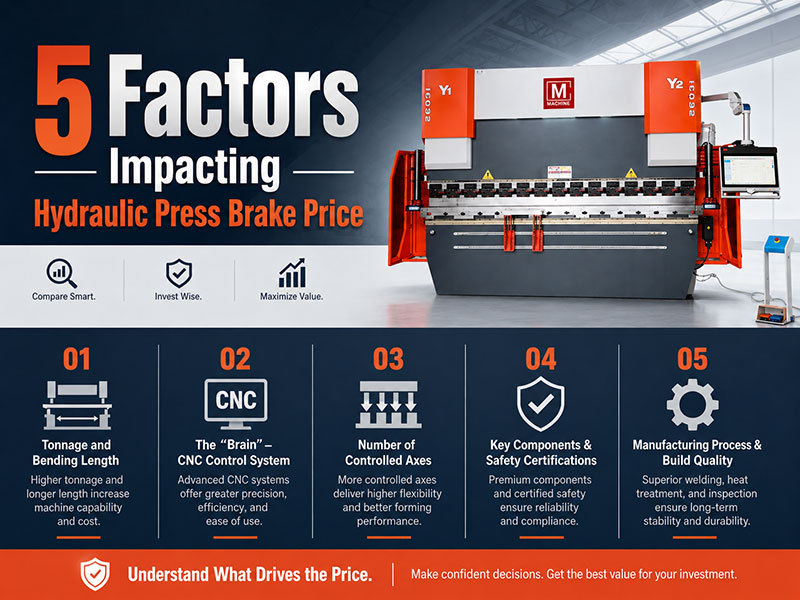
There is a significant difference in raw material costs between the 100T/3200mm and 300T/4000mm models. As the 300T model is designed to withstand three times the pressure, the steel plates forming its frame must be substantially thickened, resulting in a manifold increase in its overall weight.
Increasing the throat depth and daylight opening height compromises the rigidity of the machine frame; consequently, it becomes imperative to significantly increase the thickness of the steel plates and reinforce the structural design to prevent deformation. These exceptionally stringent requirements for structural stability not only necessitate a greater volume of high-strength steel but also mandate the upgrading of core components—such as large-scale hydraulic cylinders—thereby driving up the overall cost of the machine significantly. Selecting a machine size that is excessively large results in energy waste, whereas selecting one that is too small risks damaging the machine frame.
NC Controllers (e.g., E21/E300): Suitable for simple processing and are low-cost.
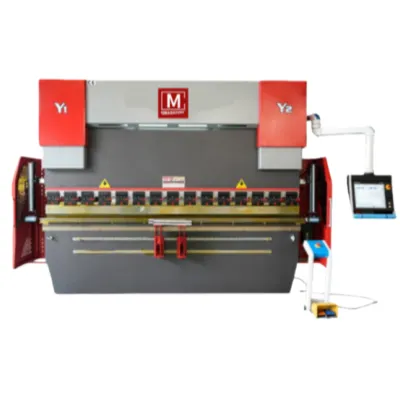
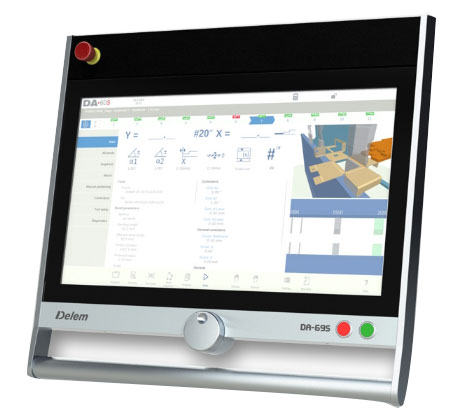
High-end CNC Systems: DELEM DA69T, DA66T, DA53T, DA58T.
The Dutch DELEM system is a leading, high-end brand in the industry; the DA69T and DA66T models support 3D simulation and collision detection, while the DA58T and DA53T models are intuitive and user-friendly. Its key strengths lie in its exceptionally high calculation precision and extremely stable operation. Through offline programming and precise axis control, the system significantly reduces operational complexity, shortens machine setup times, and ensures both high workpiece precision and production efficiency.
The DELEM DA69T/66T system features 3D visualization, offline programming capabilities, exceptional stability, and global after-sales support. MIHARTING Advantage: We offer the original DELEM system from the Netherlands—available as either a standard or optional feature—to ensure precise and effortless operation.
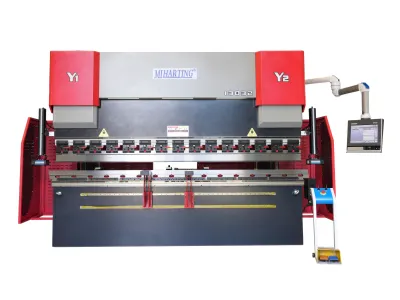
The distinction between a basic 3-axis system (Y1, Y2, X) and more complex 6+1 or 8+1 axis systems lies in their respective capabilities: the 3-axis system handles fundamental bending operations, whereas the 6+1 and 8+1 axis systems incorporate additional control over height, lateral positioning, and automatic compensation. The greater the number of axes, the less human intervention is required, enabling the fully automated execution of complex processing tasks and resulting in a significant boost in efficiency.
The dynamic mechanical compensation system (V-axis Crowning) significantly impacts the precision of long workpieces—a factor that also serves as a key determinant of a machine's price. Through precise wedge adjustments, V-axis mechanical compensation counteracts structural deformation caused by bending forces on long-bed machines, thereby ensuring consistent bending angles across the entire length of the workpiece. This configuration effectively eliminates the common issue of "excessive angles in the middle section" of a workpiece; it is the core technology for guaranteeing high-precision processing of long parts and marks the critical price demarcation between mid-to-high-end models and their lower-cost counterparts.
The hydraulic valve assemblies from German manufacturers Bosch Rexroth or Hoerbiger offer high stability.
Electrical components from brands such as Schneider demonstrate excellent durability.
Compliant with CE certification and ANSI/OSHA standards.
The impact of laser safety devices (e.g., DSP/FIESSLER) on operator protection and machine cost.
The steel plates undergo annealing after welding to relieve internal stresses and prevent deformation of the machine frame.
MIHARTING utilizes floor-type and gantry-type machining centers to perform a secondary, comprehensive machining operation on the frame structure, thereby ensuring the parallelism and perpendicularity of all mounting surfaces.
High-end 42CrMo molds also contribute significantly to the final bending precision.
Overall, Hydraulic Press Brake Price is a significant factor influencing quality; therefore, one should prioritize value for money rather than simply seeking the lowest price.
Need a precise quote for your project? Contact our engineers today.Download our latest Hydraulic Press Brake Catalog.
[Hydraulic Press Brake Catalog] [Get a Free Quote]

 English
  中文
中文