Jun 02, 2026
In sheet metal fabrication, the selection of the appropriate tonnage for a CNC press brake machine directly determines the quality of the formed product, the service life of the equipment, and operational safety. Insufficient or excessive tonnage can lead to wear and tear on the machine frame. Accurately determining the required bending tonnage helps prevent quality issues such as deformation, springback, and dimensional deviations.
This article will focus on bending tonnage calculation formulas, step-by-step calculation methods, and industry-standard tonnage reference charts to assist you in selecting the optimal tonnage for your bending machine.
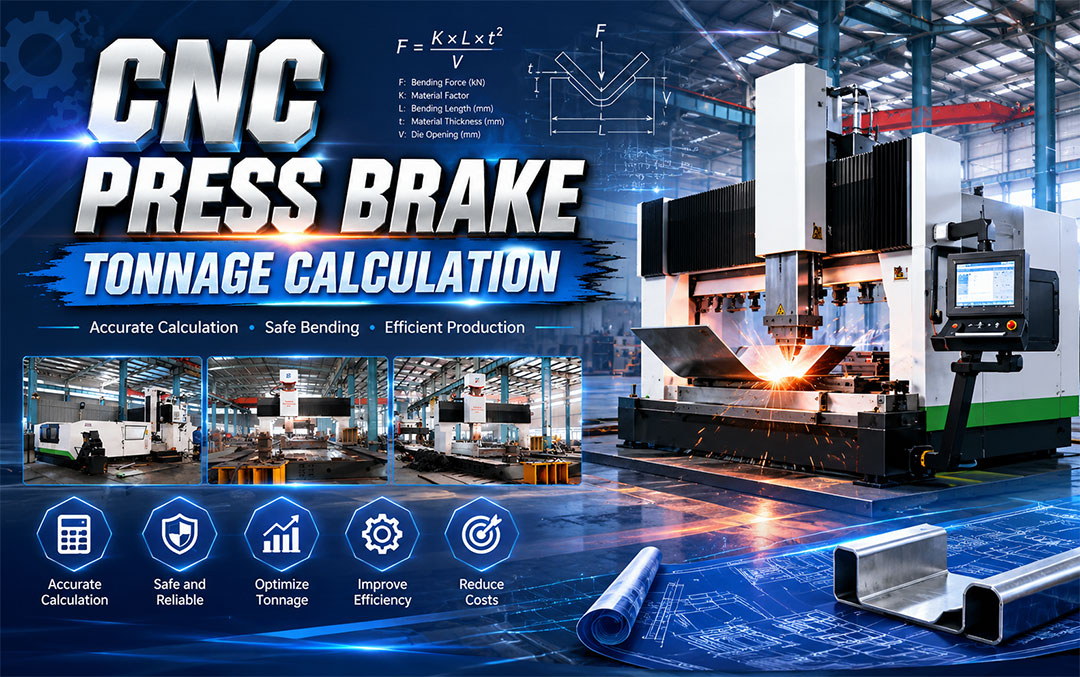
The calculation of bending tonnage is based on the material type, thickness, bending length, and lower die opening width of the sheet metal, with the aim of determining the minimum pressure required to bend the material. This calculation is then refined through reasonable adjustments based on the material's hardness and specific bending conditions. All these parameters are indispensable; the core influencing factors are as follows:
• Sheet Thickness (T): Tonnage requirements increase exponentially with thickness, making it the primary factor influencing the required pressure; bending thick plates requires significantly higher pressure than bending thin plates.
• Bending Length (L): The greater the effective bending length of the sheet metal, the higher the uniform bending pressure required, resulting in a proportional increase in tonnage demand.
• Lower Die Opening Width (V): The industry-standard guideline is "6 to 8 times the sheet thickness." The narrower the die opening, the greater the resistance to bending, and consequently, the higher the required tonnage.
• Sheet Material: The hardness of the material directly determines the correction coefficient. Stainless steel, being significantly harder than carbon steel, requires 50% to 80% more tonnage than carbon steel for the same specifications; conversely, aluminum alloys, having lower hardness, require less tonnage.
This article utilizes the universal national standard calculation formula widely adopted in the sheet metal industry. It is applicable to the vast majority of common right-angle bending scenarios, yielding precise results that closely align with actual production conditions. As such, it serves as a fundamental basis for factory equipment selection and process optimization.
Standard Calculation Formula
Required Bending Tonnage (T) = 650 × Sheet Thickness² (mm) × Bending Length (m) ÷ Lower Die Opening Width (mm)
Formula Applicability: This formula applies to standard operating conditions involving room temperature, standard right-angle bending (90° sheet forming), and the absence of hemming (flattening) or tensile deformation. The baseline material for this formula is standard carbon steel (Q235).
Step-by-Step Calculation Tutorial
Step 1: Determine Basic Parameters
Identify the sheet material, thickness (T), effective bending length (L), and the selected lower die V-opening width (prioritizing the standard guideline of 6 to 8 times the sheet thickness).
Step 2: Apply Basic Formula to Calculate Baseline Tonnage (for Carbon Steel)
Example: Processing Q235 carbon steel with a sheet thickness of 3 mm and a bending length of 2 m, using a 24V lower die (representing a standard opening of 8 times the sheet thickness).
Calculation: 650 × 3² × 2 ÷ 24 = 48.75 tons
Step 3: Adjust Tonnage Based on Material Type
Since different materials possess varying hardness levels, the calculated tonnage must be multiplied by a corresponding correction coefficient to accurately match actual production requirements:
• Standard Carbon Steel (Q235/Q345): Correction Coefficient 1.0
• Stainless Steel (304/316): Correction Coefficient 1.6–1.8
• Aluminum Alloy Sheet: Correction Coefficient 0.6–0.7
• High-Strength Steel Plate: Correction Coefficient 1.2–1.4
Step 4: Incorporate a Safety Margin
In actual production environments, it is recommended to add a safety margin of 10% to 20% to the calculated result. This precaution helps prevent insufficient pressure caused by sheet material tolerances, temperature fluctuations, or die wear, thereby ensuring the stable and reliable operation of the equipment.
To facilitate quick and convenient selection, we have compiled a standard bending tonnage chart—widely used within the industry—based on a 1-meter bending length (utilizing standard V-dies, 90° right-angle bends, and ambient temperature conditions). This eliminates the need for manual calculations; simply refer directly to the chart.
Sheet Thickness | Standard V-Die | Carbon Steel Tonnage/Meter | Stainless Steel Tonnage/Meter | Aluminum Alloy Tonnage/Meter |
1.0mm | 8V | 8T | 13T | 5T |
1.5mm | 12V | 12T | 20T | 7T |
2.0mm | 16V | 16T | 27T | 10T |
2.5mm | 20V | 20T | 34T | 12T |
3.0mm | 24V | 24T | 41T | 15T |
4.0mm | 32V | 32T | 54T | 19T |
5.0mm | 40V | 40T | 68T | 24T |
6.0mm | 48V | 48T | 82T | 29T |
8.0mm | 64V | 65T | 110T | 39T |
10.0mm | 80V | 82T | 140T | 49T |
Note: For bending lengths exceeding 1 meter, the required tonnage may be scaled up proportionally. For narrow V-dies, thick plates, or precision bending applications, an additional tonnage margin of 10%–30% must be added.
Standard formulas and reference charts are applicable only to routine bending scenarios. For the following special conditions, tonnage requirements must be adjusted; otherwise, poor bending quality or equipment overload is highly likely:
• Narrow-Flange Bending / Small-Margin Bending: When the bending flange width is less than three times the plate thickness, stress becomes highly concentrated within the material; therefore, the required tonnage must be increased by 20%–30%.
• Hemming (Flattening):The process of compressing a double-layered fold into a flat hem doubles the resistance; consequently, the required pressure must be increased by more than 50% over the initial bending tonnage.
• Ultra-Thick Plates / High-Hardness Materials: For high-strength steel plates or quenched (hardened) plates, it is recommended to maintain a safety margin of at least 30% to prevent equipment overload.
• Extra-Long Plates: For thin plates exceeding 3 meters in length, central deflection (bowing) is a common issue. This requires the use of deflection compensation systems, accompanied by a slight increase in bending tonnage.
Many instances of equipment failure and product scrap in fabrication shops stem directly from errors in tonnage calculation. The following four high-frequency pitfalls must be avoided:
• Pitfall 1: Focusing solely on plate thickness while ignoring material properties (grade/alloy).
• Pitfall 2:Arbitrarily selecting the V-die opening size without proper analysis.
• Pitfall 3:Failing to incorporate a safety margin into the calculation.
• Pitfall 4:Applying a single, uniform tonnage setting for all bending lengths.
Bending tonnage requirements are influenced by a multitude of factors—including material type, thickness, length, bending process, and die specifications. Any miscalculation can result in significant production losses.
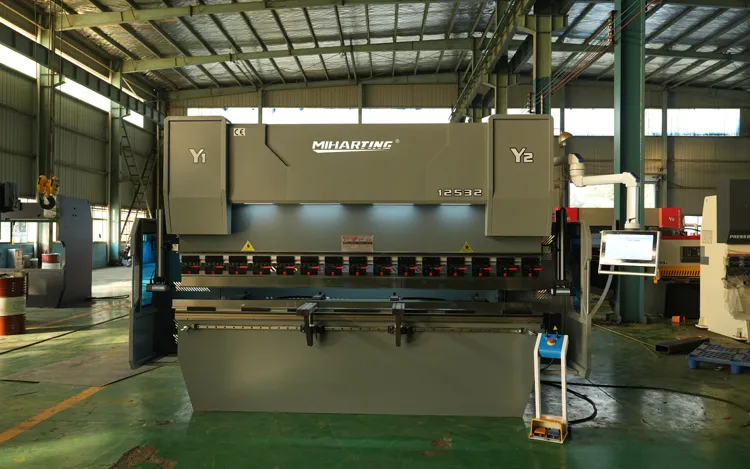
Miharting offers a complimentary, personalized service for precise tonnage calculation and press brake equipment selection. Simply submit your plate specifications to us; we will quickly and accurately calculate the exact bending tonnage required for your application, and provide targeted recommendations for the most suitable CNC press brake models—helping you save costs, mitigate the risk of equipment overload, and ensure bending precision.
 English
  中文
中文