Jun 24, 2026
For sheet metal manufacturers, the press brake is no longer just a bending machine. It is a cost-control tool, an energy-consumption factor, and a long-term productivity investment.
As electricity prices, labor costs, and environmental requirements continue to rise across Europe, North America, the Middle East, and other high-energy-cost markets, buyers are asking a practical question:
Should we choose a pure electric press brake, a hybrid servo press brake, or a traditional hydraulic press brake?
Each option has clear advantages. The best choice depends on production volume, material thickness, accuracy requirements, energy costs, and return on investment. This article compares the three main press brake technologies and explains why oil-electric hybrid servo press brakes are becoming a smart middle-ground solution for many manufacturers.
Traditional hydraulic press brakes have been widely used for decades. They rely on hydraulic pumps, valves, cylinders, and oil pressure to generate bending force.
High tonnage capability
Hydraulic press brakes are suitable for thick plates, long bending lengths, and heavy-duty applications. For manufacturers working with structural steel, shipbuilding parts, large cabinets, or construction machinery components, hydraulic systems remain highly practical.
Lower initial purchase cost
Compared with pure electric or advanced hybrid servo machines, traditional hydraulic press brakes usually have a lower upfront price. This makes them attractive for workshops with limited budgets.
Proven technology
Maintenance teams are often familiar with hydraulic systems. Spare parts are widely available, and many operators already understand the basic working principle.
High energy consumption
A conventional hydraulic pump often runs continuously, even when the machine is idle. This leads to unnecessary electricity usage throughout the working day.
Higher oil and maintenance costs
Hydraulic oil, seals, filters, valves, and hoses require regular inspection and replacement. Oil leakage can also affect workshop cleanliness and machine reliability.
More heat and noise
Traditional hydraulic systems generate more heat and noise, which can increase cooling requirements and reduce operator comfort.
Lower long-term efficiency
Although the initial cost may be lower, operating expenses can accumulate quickly, especially in countries where industrial electricity prices are high.
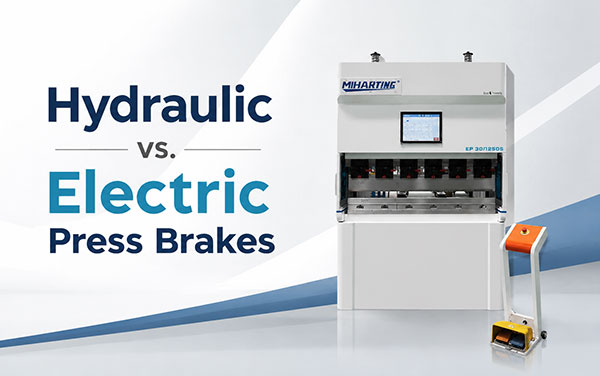
Pure electric press brakes use servo motors and mechanical drive systems instead of hydraulic oil to control ram movement.
Excellent energy efficiency
Pure electric machines consume power mainly during active bending movement. This can significantly reduce energy waste compared with conventional hydraulic systems.
High precision and repeatability
Servo-driven control provides accurate positioning, fast response, and excellent repeatability. This is especially useful for precision sheet metal, electronics, elevator parts, medical equipment, and stainless steel products.
Low maintenance
Without hydraulic oil, pumps, or valves, maintenance is simpler. There is no oil leakage, less heat generation, and a cleaner working environment.
Fast response speed
Pure electric press brakes can be very efficient for small and medium parts, especially in high-mix, low-volume production.
Higher initial investment
Pure electric press brakes usually cost more than traditional hydraulic machines, especially for larger sizes or higher tonnage requirements.
Limited heavy-duty capability
For very thick materials or large bending lengths, pure electric solutions may become expensive or less practical compared with hydraulic-based systems.
More suitable for specific applications
Pure electric machines are ideal for precision and light-to-medium bending, but may not be the best economic choice for all workshops.
Oil-electric hybrid servo press brakes combine the strength of hydraulic bending with the efficiency of servo motor control. Instead of running a hydraulic pump continuously, the servo motor drives the pump according to real-time bending demand.
This design reduces wasted energy while keeping the high tonnage performance and bending stability of hydraulic systems.
Energy savings of up to 50%
Compared with traditional hydraulic press brakes, a hybrid servo system can reduce energy consumption by around 50%, depending on workload, material type, bending frequency, and operating conditions.
Strong bending power
Unlike many pure electric machines, hybrid servo press brakes are suitable for medium and heavy-duty bending applications. They can handle thicker plates and longer workpieces while still improving energy efficiency.
Lower operating cost
Reduced power consumption means lower monthly electricity bills. For buyers in high-energy-cost countries, this saving directly improves ROI.
Less oil heating and longer component life
Because the hydraulic system works only when needed, oil temperature rises more slowly. This can reduce stress on seals, valves, and pumps, helping lower maintenance costs over time.
Better accuracy than traditional hydraulic machines
Servo-controlled hydraulic movement improves ram positioning, repeatability, and bending consistency.
Quieter and cleaner operation
The machine is quieter during standby and generates less heat, creating a better workshop environment.
Higher price than traditional hydraulic machines
Hybrid servo machines require a larger initial investment than conventional hydraulic press brakes.
More advanced control system
Maintenance teams may need basic training on servo systems, CNC controls, and parameter settings.
ROI depends on utilization rate
The more frequently the machine is used, the faster the energy savings can offset the initial investment.
When comparing press brake ROI, buyers should look beyond the purchase price. A lower-cost machine is not always cheaper over five or ten years.
Key ROI factors include:
Initial machine price
Electricity consumption
Daily operating hours
Labor efficiency
Maintenance cost
Oil and spare parts cost
Bending accuracy and scrap reduction
Machine downtime
Production capacity
| Press Brake Type | Initial Cost | Energy Consumption | Maintenance Cost | Best For | Long-Term ROI |
|---|---|---|---|---|---|
| Traditional Hydraulic | Low | High | Medium to High | Heavy-duty bending, limited budget | Moderate |
| Pure Electric | High | Very Low | Low | Precision, small-to-medium parts | High in suitable applications |
| Hybrid Servo | Medium to High | Low | Medium to Low | Medium/heavy bending with energy savings | Very strong balance |
For many manufacturers, the hybrid servo press brake offers the best balance between investment and return. It does not require the very high cost of large pure electric systems, but it can significantly reduce the energy waste of traditional hydraulic machines.
In regions where electricity prices are high, energy efficiency is not just an environmental benefit. It is a purchasing priority.
Manufacturers in Europe, North America, Australia, the Middle East, and other energy-sensitive markets are under pressure to reduce operating costs while keeping production stable. A traditional hydraulic press brake may appear economical at the time of purchase, but the long-term electricity cost can become a burden.
A hybrid servo press brake directly addresses this pain point.
By saving up to 50% energy compared with conventional hydraulic systems, it helps manufacturers:
Reduce monthly power bills
Improve equipment ROI
Meet energy-saving procurement standards
Lower workshop noise and heat
Reduce hydraulic system wear
Improve bending accuracy and consistency
For purchasing managers, this means the machine is not only a production tool, but also a long-term cost-reduction asset.
You have a limited budget, lower electricity costs, and mainly need a reliable machine for general heavy-duty bending.
You produce small or medium precision parts, require very high repeatability, and want a clean, low-maintenance solution.
You want the bending power of hydraulic technology, but also need lower energy consumption, better accuracy, reduced noise, and stronger long-term ROI.
For many sheet metal factories, especially those working in high-energy-cost countries, the hybrid servo model is the most practical upgrade path.
The future of press brake purchasing is not only about tonnage, bending length, or machine price. It is about total cost of ownership.
Traditional hydraulic press brakes still offer strong bending capability and a lower entry cost. Pure electric press brakes deliver excellent precision and efficiency for suitable applications. But for manufacturers that need both power and energy savings, the oil-electric hybrid servo press brake provides a highly competitive solution.
With energy savings of up to 50%, stable bending performance, lower noise, and reduced operating costs, the hybrid servo press brake is an ideal choice for buyers who want to improve productivity while controlling long-term expenses.
For companies facing rising electricity prices, the question is no longer simply “Which press brake is cheaper to buy?”
The better question is:
Which press brake will cost less to own over the next five years?
 English
  中文
中文